
Transactions
Search, filter and inspect any transaction, including its disputes.
Transactions is the complete record of your payments: a secure history of every operation that you can filter, search, export, and open in detail. It also includes the Disputes sub-tab for managing chargebacks.
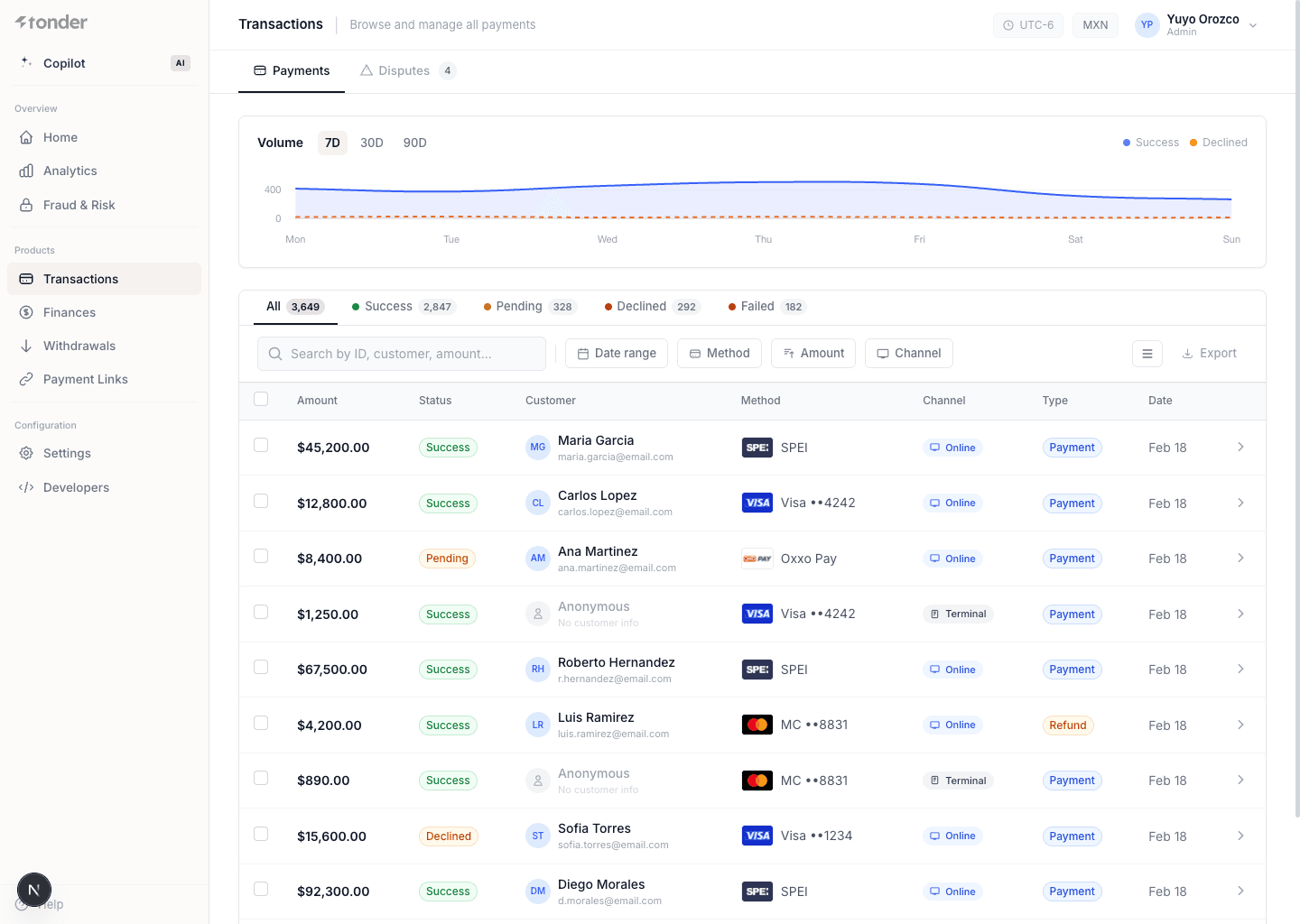
The list
Shows all your payments regardless of status. Main columns:
| Field | Description |
|---|---|
| Creation date | Date when the transaction was created. |
| Amount | The monetary value of the transaction. |
| Currency | The currency the amount is expressed in. |
| Type | Type of operation (payment, refund, etc.). |
| Status | Current status (see below). |
| Payment processor | The acquirer/processor used for the payment. |
The status tabs at the top let you jump straight to a subset (for example, only Success or only
Failed).
Statuses
| Status | Meaning |
|---|---|
Pending | In progress (includes 3DS in flight). |
Success | Approved by the bank/processor. |
Declined | Declined by the issuer. |
Failed | Failed during processing. |
Transaction synchronization that goes through 3DS can take a few minutes to change from Pending to
Success in the dashboard, but this does not affect the end user.
Filters and search
| Filter | Description |
|---|---|
| Status | Narrow down by current status. |
| Amount | Filter by a monetary value or range. |
| Date | Focus on transactions in a date range. |
| Payment method | Filter by payment method. |
Search accepts identifiers such as Payment ID or Order ID.
Data export
Click Export (top-right corner), select the date range, and confirm to download a CSV.
Transaction details
Click a row to open the detail panel:
| Section | What it shows |
|---|---|
| Payment details | Transaction ID, Direct API ID, Payment ID, Order ID, Fee, Net. |
| Customer | Name and email. |
| Risk assessment | Guardian score out of 100. |
| Timeline | Chronological events: Payment created, Guardian approved, Payment attempted. |
| Raw data | Collapsible section at the end of the panel with the processor's full response. |
From this page you can also issue refunds with the button in the top-right corner.
Finding the decline reason
Filter by the Declined status tab, click the row, and expand the RAW DATA section at the
bottom of the detail panel. The relevant fields are responseCode and responseText for the code
and description, and processorError with processorMessage when the decline comes directly from
the processor. What each code means is in Decline codes.
The Home screen also has a Top decline reasons widget listing the most frequent reasons for the period, with their count and their soft/hard classification.
All five roles can view and search transactions. The Guest role has read-only access with masked data, so some fields may not be visible. If a team member cannot see a field, check their role in Team Members.
The ability to issue partial refunds may vary depending on each processor's policies.
Disputes
The Disputes sub-tab centralizes chargebacks and retrieval requests. From there you can view each dispute, accept or reject it, and export the list. Access to these actions depends on the user's role.
Disputes list
| Field | Description |
|---|---|
| Amount | The monetary value of the disputed transaction. |
| Status | The current status of the dispute (e.g. open, closed). |
| Card | The card used for the transaction being disputed. |
| Payment Processor | The payment processor involved in the transaction. |
| Time to answer | The available time to respond to the dispute (only available if the payment processor is Tonder). |
Dispute details
Clicking a dispute opens its detail view:
| Field | Description |
|---|---|
| Network reason code | The code indicating the reason for the dispute (assigned by Visa/Mastercard). |
| Dispute ID | Unique identifier for the dispute. |
| Client Info | Information about the client associated with the dispute. |
| Timeline | Chronological sequence of events for the dispute. |
From the detail view you can accept the dispute (acknowledge the chargeback without contesting it) or dispute it (upload evidence to challenge the cardholder's claim).
Dispute process timing
- Cardholders can initiate a dispute up to 120 days after the original transaction.
- You have 15 days to submit evidence after receiving the notification. See Handling Disputes for the full per-market deadlines.
- The issuing bank takes 60-75 days to assess the evidence and decide.
- The full dispute process typically takes 2-3 months from start to finish.